 I'm always a little antsy when there isn't a moon and blue sky beckons late in the afternoon! Particularly this time of year (Spring) when the Summer Milky Way rises in the early evening providing a plethora of pleasing perspectives! And it was special this time as my friend Dick had offered to let me borrow his recently acquired small telescope - a William Optics 71mm F/4.9 astrograph. What does all that mean? Well, it is a small scope, only 71mm diameter, and short-focus, so provided a wide field of view. Its 4-element design also provides a wide field of view, and a flat focal plane so it should be in focus across a full 35mm film format. So I was anxious to use it and another friend Laurie wanted some dark sky time too last weekend, so plans were made! Another buddy Roger heard about the outing and had a new 10" refractor he was willing to bring along for some visual viewing, so it was a trio! The lil' telescope is shown at left...
 We didn't feel like going a long way, so decided to head out to Empire Ranch, where the Tucson astro club used to observe for many years. What we didn't plan on was that many others would be breaking their "shelter at home" stint - the old airstrip we used to use was filled with a good 10 or 12 RVs and plenty of ATVs rolling around as sunset approached. We headed to the far eastern end and found a relatively secluded spot and no one bothered us most of the night, though loud rock music wafted our way, only pissing-off one of our trio! First order of business, even before setting up gear, was to take a set of sky flats while it was still light. Regardless of how good the optics are, there are always some non-uniformities in illumination across the field of view. If you photograph a blank, uniform sky, you can help "flat field" the images to correct for vignetting - light falloff towards the corners of the frame. At right is shown the final stack of 12 shots of the overhead sky taken at 4 different rotation angles to average out any gradients in brightness... Contrast was adjusted to bring out variations, but generally the center of the field is a little brighter than the corners (by a fraction of a percent), and the shadow at the bottom is likely caused by the DSLR mirror shadow, flipped out of the way during the exposure...
 I chased a few favorite targets to see how the William Optics system performed. First up was nearing the meridian (due south) as it got dark, Omega Centauri, one of the most spectacular objects in the sky! Located pretty far south, it isn't visible from the Midwest, but clears the horizon by about 8 degrees from AZ. It is called a globular cluster - a collection of upwards of millions of stars. Omega is said to contain up to 10 million, and is located about 16,000 light years generally towards the center of the galaxy from where we are. Its fuzzy appearance can be detected by eye, and even in binoculars is a very nice sight. A small telescope starts to resolve it into the multitude of stars, and a photograph like this one starts to see the small color variations in the stars. Believe it or not, this is a stack of 5 exposures only 30 seconds long each - so only 2.5 minutes total exposure! It is cropped and enlarged to show the full resolution of the camera. The images look very good indicating the optical system is a very good performer!
 Next up was a test of scattered light and sensitivity to faint objects. Lower in the west, was Leo, and one of the easiest galaxies to find, even though it wasn't discovered until 1950! Find the brightest star in Leo - that would be Regulus, and point just north of it. The dwarf galaxy Leo 1 (UGC 5470) will be in your field... At 11th magnitude, it is likely one of the 200 brightest galaxies in the sky, but it was hidden behind the glare of Regulus until 70 years ago... Only 800,000 light years away (about one third the way to the Andromeda Galaxy), it is thought to be a satellite gravitationally bound to our Milky Way... It is the little smudgy glow above the bright star. BTW, North is up in all of these images!
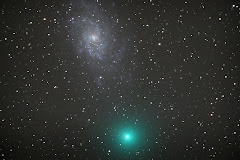
 Next up was the surprise of the night! Even though it was hanging over the glow of Tucson, the galaxy Messier 81 and 82 are the perfect sort of targets for this lens. But thanks to the wide field of view of this lens, as the first image read out, I spotted the green glow of a comet - sporting a tail too! Someone had mentioned that "bright' comet C/2017 T2 PANSTARRS was going to be adjacent to this pair, but had promptly forgotten... This comet was discovered 2.5 years ago by the Panoramic Survey Telescope and Rapid Response System located at Haleakala Observatory in Hawaii. On this night it was about 150 million miles from both the sun and the earth. It has passed it's closest point to the Sun and Earth, and will now be slowly fading... This is only 8 minutes of stacked exposures, But even in those 8 minutes, the comet has trailed slightly. I chose to leave the galaxies sharp rather than center on the comet and trail the galaxies the small amount...
 Then it was time - my favorite part of the sky finally got high enough to shoot. The area around the star Antares in the constellation Scorpius is full of globular star clusters, as well as bright and dark nebulae. How do you see a dark nebula, you ask? Well, you see it silhouetted against the star-filled background! It makes for a fantastical field. Here is a 3-frame mosaic of the area, since the field of interest is larger than can be taken in one field... Each of the 3 frames is 5 frames of 2 minutes exposure each, then assembled in Photoshop. Antares is the orange star below center - the brightest star in Scorpio. To its right is a fuzzy area - another globular star cluster, this one being Messier 4 - another object easy to find - shift west from Antares! The streams of dark clouds just knocks me out!
1600 pixels wide is not enough for these images (the limit for blog photo dimensions). So at right is the full-resolution blow-up of the part of the frame right around Antares and M4. The little fainter globular between them and a little higher has the romantic name of NGC (New General Catalog) 6144.
 By this time of the night my compatriots were starting to pack it in. I always like to finish off an evening by taking a test shot of a field to see how it will look. In this case I finished with a pair of exposures of the brightest part of the Milky Way above the spout of Sagittarius' teapot. For just 4 minutes of exposure tens of thousands of stars are shown. Right at center, is one of my favorite objects - a little dark nebula between a small cluster and bright star. Barnard 86 (The Inkspot Nebula) is always fun to show people in my 14" telescope at the Grand Canyon Star Party (from a VERY dark sky). Lower left from that is B90. Most of the dark clouds in this field have Barnard designations - recorded and discovered photographically 120 years ago!
I hated to leave with such a beautiful Milky Way arching overhead, but it was after 1am. My opinion of the WO71mm? I thought it was great! It has a beautifully wide field, yet is high enough quality to support full-resolution framing and crops. If Dick ever tires of it and wants to find it a new home, would be glad to use it again in the future!











 Posts
Posts



